
The Local Community Has Collapsed. The Answer is Your Local Community
How I learned the value of community working in one of the key institutions that supported it while it was falling apart.

Think Global, Act Local
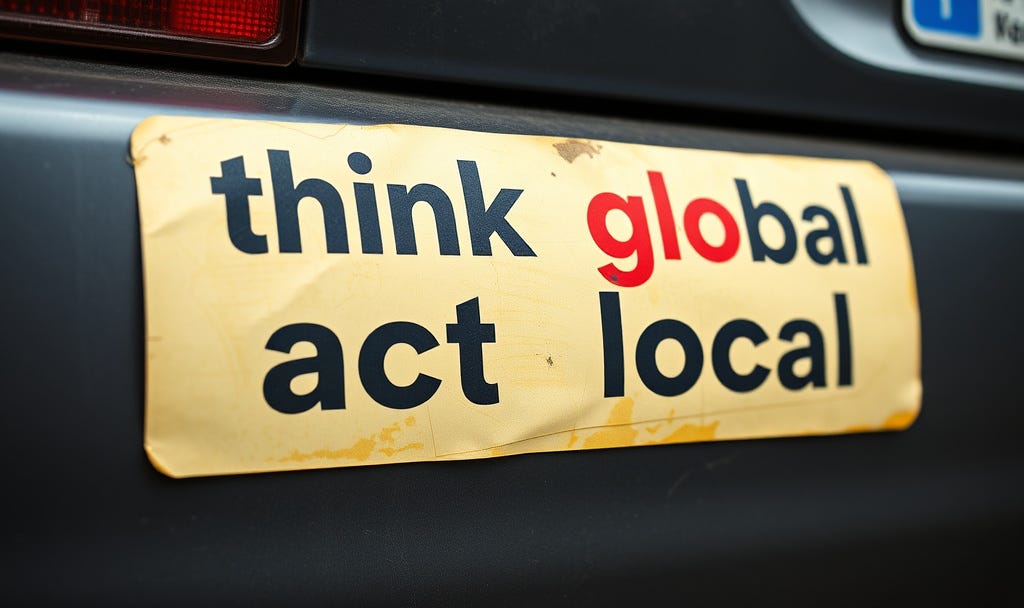
I believe in a bumper sticker. A very specific one from the last century I finally came to understand a little bit late: “Think global, act local.”
It’s common sense to a certain person today. But the cliche held no appeal to me growing up in the suburbs in the 1990s; in that environment the notion of a local community wasn’t a cohesive thing in my mind. What you might have called my community at the time was fragmented between a few neighborhood friends (themselves scattered among houses that were by and large occupied by strangers I never met), family we might catch up with on the weekends, and centered around school friends, most of whom lived several miles away thanks to school open enrollment policies.
This suburban alienation was probably best illustrated in my friends’ favorite weekend activity. Just simply driving around the expanse of the Denver metroplex. Not cruising the mall or the strip or any other popular place where we might see or be seen by peers like millions do in small towns or actual communities. The goal was rarely in search of connection or community. It was just aimless roaming, wandering. For the alienated, there is no destination because it’s assumed to be unattainable.
The Power of Just Talking to People Doing Things
My adolescent cynicism was pierced a few years later on my first assignment in journalism school. I still remember the name of the first person I ever interviewed for that story — Devear Redden, a volunteer for the Salvation Army in Columbia, Missouri. It was the archetypal basic, fluffy, feel-good news article about the local food pantry in a college town. But putting my name to an article that highlighted an actual positive action in my community at the time may have been the first time I felt a real connection to the word. Or at least it was the first time I noticed or didn’t take that connection for granted.
It caught me by surprise. I hadn’t come to journalism school with the aim of doing much actual journalism—I just knew that the broadcast journalism program would put me on the local television channel for a year or two, and in my slightly delusional and alienated suburban mind, that seemed like a potential path to me becoming the next Conan O’Brien. Although I would remain resistant to the notion that journalism and not comedy or entertainment might be my real calling, the experience of finding satisfaction from a newsroom shift or reporting from the field continued to repeat itself during my time in college.
Alaskan Radio Changed My Perspective
World events and economics conspired to send me on a path shortly after graduation to one of the most rural and remote places on Earth — the roadless Alaskan Bush. Sight unseen, I signed a two-year contract to move to a village of 700 people that was accessible only by small passenger planes.
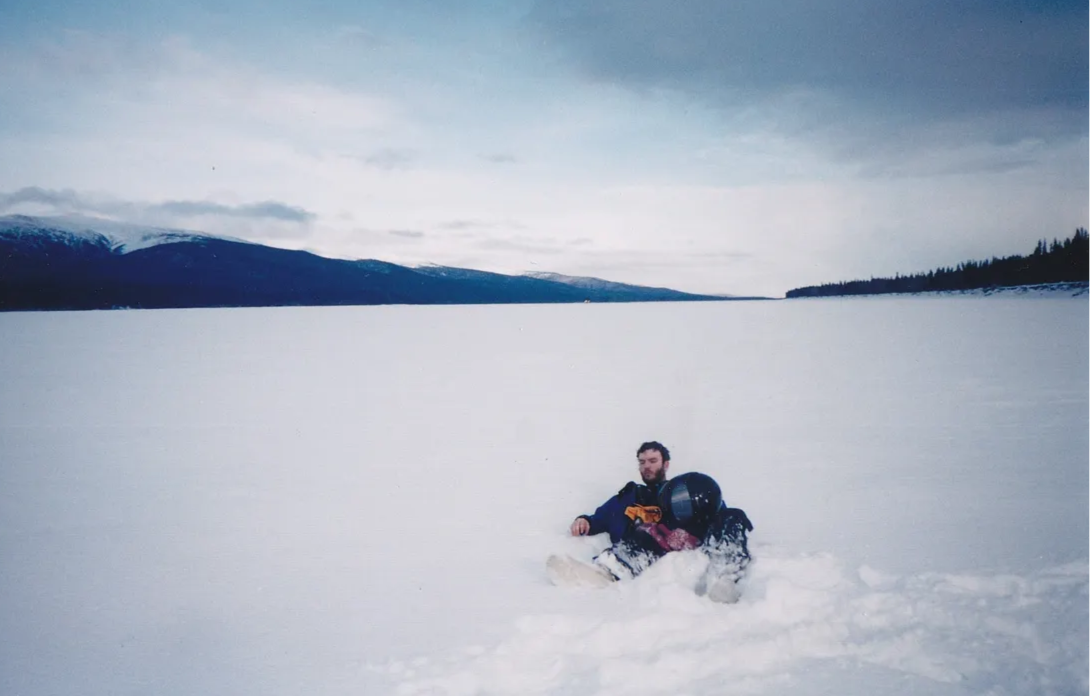
To the surprise of many family and friends, I was thrilled. As I made my arrangements to travel to my new home for the first time, I indulged in fantasies of what it would be like to live in an actual community for the first time, not the contrived community of a college dorm or a corporate workplace, but a vintage village set amid a vast wilderness. I imagined myself arriving in town to a fanfare of appreciation; I would be welcomed for my many talents: I could coach the first football team in the history of the village; hold salons on the postmodern literary stylings of Dave Eggers and Jonathan Franzen; best of all I could start an improv comedy troupe sure to be as beloved as the Comedy Wars crew at the University of Missouri.
Absolutely none of these things happened, even though I actually stayed for 4 years in the village. But I did get a taste of what living in actual community is like. The best parts were even better than I imagined; the worst parts were devastating and made staying beyond the length of time I did untenable. The thing to know here is that the remoteness and often extreme environment of a sub-Arctic Alaskan village act as an amplifier for everything. The highs were higher and the lows were lower. But the overall sense of being part of a community bound by shared geography, history and struggles stuck with me. It felt like something that was missing from my life and maybe more importantly, something that was missing from the lives of many, many others.
A Valued Voice in the Wilderness
Most of the time I was in rural Alaska, I was at the center of the community as the voice of the local radio station. Alaska still has a robust network of community radio stations that are a lifeline for its many remote communities. In fact, part of my job was to send messages to people at even more remote settlements (very slow satellite internet and echo-y satellite phones were extremely high-priced luxuries at the time) over the air. In between the news of wars abroad and drama in Washington, DC, I would inform Betsy that she had left her colander at Margie’s cabin or some other such big-time breaking news alert.
I finally understood what “Think global, act local” really looked like in practice. It’s easy to dismiss these kinds of mundane small town interactions as quaint, but it’s what community is: mutual aid, solidarity, free association and maintaining a sense of place and identity among the broader chaos of the world.
Stack up all those quaint interactions over years, decades, generations and it can become a strong safety net to catch a community’s individual members when catastrophe strikes, like in the case of the local fishery collapsing or a destructive storm or an outbreak of youth suicides (unfortunately I saw the role community played in reacting to all these scenarios during my time there.)
Covid-19 and the Collapse of Community
Fast forward fifteen years to the catastrophe of Covid-19. I was no longer in Alaska, but instead in the process of moving off-grid in rural New Mexico. In the early weeks of the pandemic I saw the familiar rallying effect of communities at home and around the world. But it was striking how short-lived that phase of solidarity and mutual aid was, both in our small town community and elsewhere, especially throughout the United States.
At this point several books have been written about both the uneven and lackluster response to Covid, and the sociopolitical polarization that exacerbated it even more.

But one piece of the puzzle that I think remains under-discussed is the collapse of community, in particular of community newspapers, radio stations and other local media outlets since the turn of the century. We know that over 3,200 local newspapers have vanished since 2005 in the United States alone — a tally that doesn’t capture countless other radio and print outlets downsized or consolidated into shells of their former selves.
The result is the disappearance of community coverage, reduced accountability and efficiency of local governments that can fall into bad habits like waste, incompetence or even corruption without a watchdog on the beat. This is to say nothing of the reduction in human and community connections that local media fostered for generations. Radio and newspapers literally bring the voices of neighbors into homes on a daily basis, reducing the isolation and alienation I felt in 20th century suburbs and that we know is more endemic in developed societies today.
Worse, local media has been replaced by algorithmically driven social media that originally claimed to be on a mission to connect humanity, but adopted a business model that instead prioritizes human engagement at all costs; it’s now common knowledge that few things drive that engagement as well as ginning up anger and resentment.
The Modern Information Diet: We are What We Scroll
The disappearance of local news has left us disconnected from our own communities, and social media arguments around highly charged national and international stories have filled the gap left in our information diets. This is a terrible double whammy in that we spend time yelling at each other about things that rarely impact our actual lives and communities, while spending less time discussing ways to improve the things that do impact us and our neighbors — things we could actually do more about than just shouting online.
This is how I understand the bitterness I saw during Covid; the distrust, the finger-pointing, the uneven and ineffective response.
That response also sent me down a long path over the last several years that led to a sobering conclusion: there is no guarantee anybody is coming to help when you need it most. At least not where I live.
There are good people working every day in our federal, state, county and other local governments, as well as our schools, police, emergency responders, remaining local media and all the other components of our social fabric. It’s all mostly good people. But they are good people within systems that are all too often too ossified, hamstrung, compromised or totally broken to react to all the needs of all the people living day-to-day under the extreme complexity (wonderful as it can often be) of our modern society.
But despite it all, there is still one category of people I do think would come to help to whatever capacity they could if my family really needed it: Our neighbors and the small group of individuals closest to us that I could define as our personal community.
Community is a greatly diminished concept in 2026 America, to be sure, but it is far from extinct. The preservation of some community seems to be built into human nature. We will fiercely defend those closest to us, be it through blood relation, history or even just familiarity or shared geography. The word is empathy and it is powerful, but it doesn’t scale well. We can fret over a sick neighbor while barely considering the suffering of thousands in war or famine-stricken zones on the other side of the world; it’s just how we’re wired.
We’re built for small communities. And while I’m convinced that we’re in a period in which quite a bit is in a state of collapse around us, I’m equally convinced that rebuilding is inevitable and that it will come from the bottom up.
So go ahead, scroll and comment away at whatever culture war or conflict fills up your social feeds. It’s fine to stay informed, but if you want to take real action, you’ll do better to put the phone down and step out your door.
Somebody should come up with a way to put that on a bumper sticker.
You May Also Like:

How to Create a Simple News Diet to Improve Your Mental Health

Why You May Need to Go On a News Diet
Collapse Isn’t Coming, It’s Here

Plenty of people predict a coming collapse while others prepare for a kind of sci-fi apocalypse that sends us back to the dark ages overnight or reduces society to a brutal, Hobbesian state of nature. But history doesn’t play out nicely over 2 hours like a blockbuster screenplay, neither have historical collapses, especially at the scale of something li…