
How to Create Community
And Why it’s Important Now

We Need Community Now
In these unprecedented times, community becomes more necessary than ever. We need community that can support us physically and emotionally in our everyday lives and in times of disaster. No one can do it alone.
While Eric and I choose to live off the grid to create more independence from corporate and government utilities, we also do so to increase our connection with our natural resources and take them less for granted. We now understand that the stereotypical off-gridding homesteader who is completely independent of all others no longer stands up to scrutiny. We are more aware than ever of our interdependence with the land and the people who share it. And while we recently added a greenhouse to extend our growing season to year-round, we are not under the assumption that we can grow all our needs.
Even if we were to go back in time to the Wild West of the 1800s, no one was able to live completely independently. Even the Mountain Men came back to town to resupply occasionally. Even the ranchers were trading beef for blankets.
Our ancient ancestors lived in tribes because they were necessary for survival. Multiple people with multiple skills were needed to hunt, gather, build and create. This still holds true. Community is integral to our survival.
What is Community
Community takes many forms but first and foremost I want to make sure that we include all of the living world as our community. We live in an interconnected environment called an ecosystem where everything in the web of life is dependent on everything else and that includes us. We have the power to nurture or destroy our ecosystem. Globally, we are destroying our ecosystem by extracting natural resources at an unsustainable rate. Locally, we can work toward stewardship and a regenerative culture that aids our ecosystem and keeps it in balance. It is important that we recognize the more-than-human world in our community so we can treat it with the same respect we may treat our human community.
For most of human history, community has commonly been considered the people in our local area. Pre-internet, when we spoke of community, we meant the people we bump into at the post office, grocery store, apartment building, place of worship or at work. Classic sociology describes this as people bound by close, face‑to‑face ties in a specific place.
Obviously, this has changed with mass-communication where the world has become global, and “friends” are people who you accepted a social media invite from. The word community has become much looser due to the emergence of online communities. Some online communities stay earnest and true like the one I found on Substack, but many others are hollow forms of commodification where the word “community” stands in for “audience” or “customers.”
At its core, community is still a group of people linked by social ties, sharing common perspectives, and engaging in joint action.
Online vs. In-person Communities
For the most part, with an online community you can choose what you want to join and what you don’t want to bother with. That’s not usually true for communities in-person. You can’t choose your neighbors, coworkers, family members, etc. You are community by proximity. You can’t turn off your computer when you don’t want to deal with a member of your in-person community acting badly. In-person communities are more challenging. You must be willing to deal with the entire human with all their idiosyncrasies and social habits. You aren’t given the pleasure of a little box on the screen who only shows you what they want when they want.
Online communities are obviously easier to participate in, to find your people and to create boundaries. Maybe that’s why more people are choosing online communities to in-person ones. Screen time, packed schedules, and hustle culture make in-person communities more difficult to create and navigate. Frayed local ties means that online spaces are the easiest default mode for socialization. In our modern world, we get more practice hanging out online than talking to our literal neighbors.
But online communities are not feeding our souls the way face-to-face human interaction does. The U.S. Surgeon General declared loneliness an “epidemic” and noted that about half of American adults say they feel lonely. Loneliness is closely tied to the loss of eye contact, physical touch, and the easy back‑and‑forth of in‑person conversation that is hard to reproduce online. In national surveys, about 73% of people said that they blame technology as a major contributor to loneliness.
Online communities aren’t going to give us the socialization or shared resources that we need to thrive or to survive.
Community for Safety
Living remotely, Eric and I are aware of what it feels like not to be able to depend on government services to quickly respond in case of an emergency. Unfortunately, it might take a while for the police, fire trucks and ambulances to arrive. It is an important factor to take into consideration when living out here. Many rural communities across the United States are seeing a shortage of hospitals, medical staff, ambulances, and fire trucks, slowing down response times for emergency care.
This isn’t too dissimilar to the way our government responds to disasters.
Recent federal cost-cutting has made our government even slower to respond than it already was, as we saw in the recent Texas floods when red-tape bureaucracy and understaffed FEMA officials lost crucial time in getting aid to Texans. In an era of rapidly intensifying storms, fires, and floods, that kind of lag is a matter of life and death.
Examples like this and Hurricane Katrina, western wildfires and Covid are all representative of how we can no longer count solely on the government systems to rescue us.
Our flailing government is burdened with political polarization, corrupt prioritization, systematic limitations, and budget constraints. The Great Society Era is over. We can no longer depend on our government for assistance.
Community Working Together to Resolve Problems
Disasters and emergencies aside, in my remote community, we cannot call the police for every loose dog, gunshot fire, vandal or code violation. We don’t want to. We live in our remote off grid community to allow for a little wiggle room when it comes to freedoms, and we give that to our neighbors too. Because of this, we need to handle these situations best we can with dignity, giving people the benefit of doubt and acting with kindness when possible. But what happens when that doesn’t work?
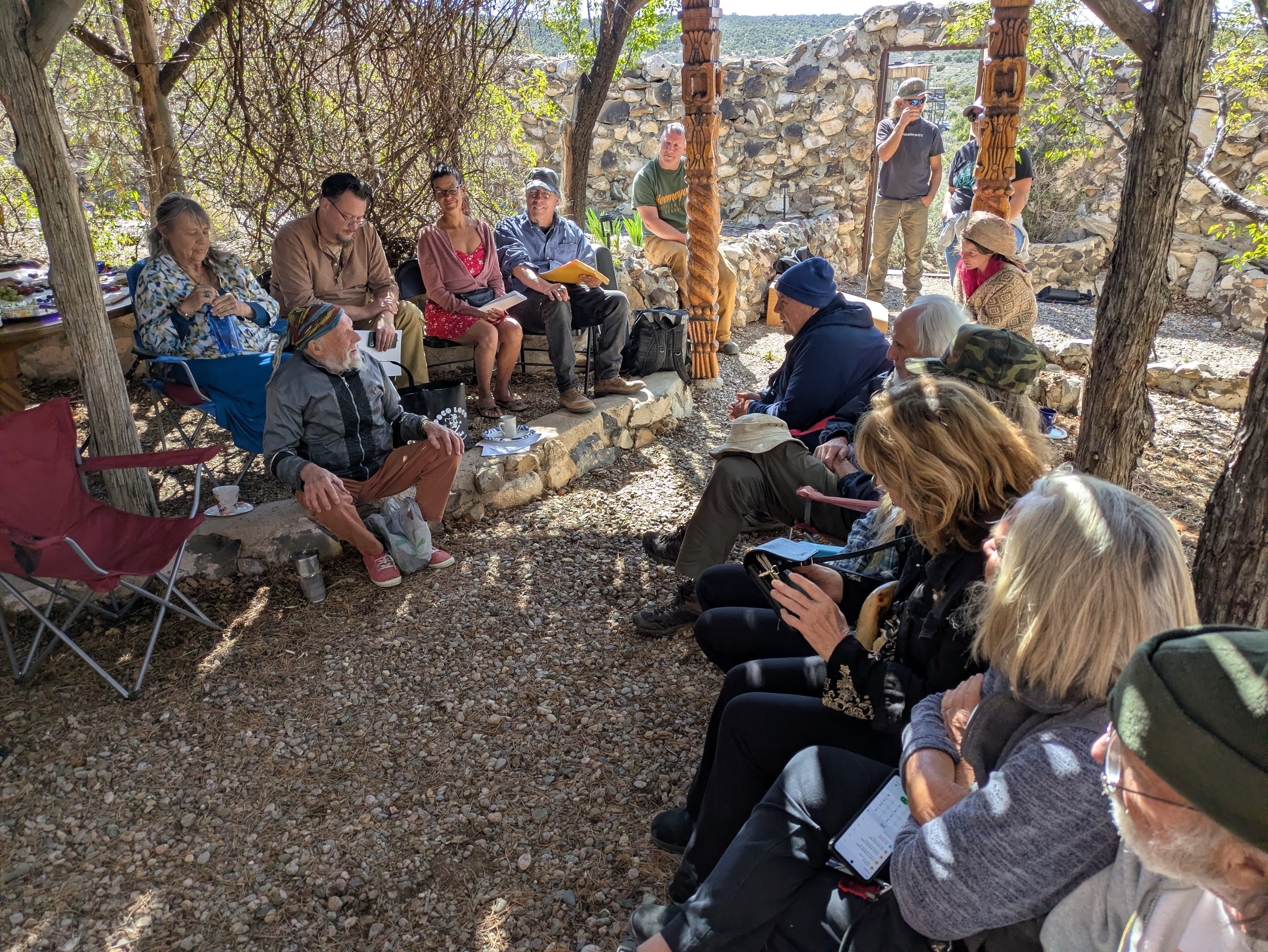
Recently my neighborhood reignited a long-lost neighborhood association, re-establishing its standing and nonprofit status. The reason for this resurgence was a sudden need to protect our neighborhood from a land grab by a profiteer. (This is a long story for another time.) Because of my interest in community and the potential I see for doing a lot of good in our off-grid neighborhood, and because they couldn’t find anyone else, I became a member of the Tres Orejas Neighborhood Association. While many people objected for fear that we would start imposing rules such as noise control or light control (which many people did want!), most people were happy to have a valid organization that could work together to make positive changes. We did not wish to impose rules, but we do hope to help neighbors that need assistance.
We are brand new and have only recently voted to pass our by-laws, but we have a vision of helping each other through skill share resources, security efforts, growing food, creating community green spaces, applying for grants for services, and having a voice in government when things like zoning or land auctions affect us.
There is no doubt that we are stronger in numbers. As an organized group, we can get so much more done. When we come together with one voice. When we share our resources. When we have each other’s backs.
I’m not going lie, we’re a ragtag group each with our own ideas, agendas and quirks. I tend to be diplomatic until you push me the wrong way. I’m not necessarily suited for office but I’m happy to help and I show up. Showing up is the most important thing and it is surprising how many people are willing to do it and how many more people aren’t.
How to Create Community
There are many ways to create community. I have other in-person communities such as my book club, yoga studio and women’s group. We come together at regular intervals with shared goals and interests. We support each other and create safe spaces to share, listen and be heard.
Consider where you already have community. Maybe at work, place of worship, clubs, sport teams or at the salon. Honor the communities that already exist in your life. If you tend to complain about these groups, see if you can bring in some gratitude instead for what they give you, such as emotional support, accountability or friendship.
Get curious about whether you could extend the purpose of any of your communities. Could you volunteer together for a charity, trade childcare, create an emergency call list or food trains for times of need? In this way, it goes from social interaction to support system.
Consider if there are already communities around you that you could be a part of such as a neighborhood association, environmental organization, food bank, local government, rotary club, parent teacher association, and the like. Go to a meeting and check out the vibe. See if this is something you could see yourself devoting your time to and if it would be a positive way to support and be supported locally.
If you have the time and the will, create your own community. First determine what your purpose is. You can write a mission statement. The mission statement for T.O.N.A. is in part, “The Tres Orejas Neighborhood Association shall endeavor to preserve the off-grid nature of Tres Orejas…shall work collectively towards shared goals that sustainably nurture, enhance, and empower our community for generations to come.” We name who we are and what we do. Perhaps yours is a group of local people who meet to discuss ways to improve your community or to share resources or to help elders or clean up your parks. Maybe you want to start a book club so you can feel inspired to read and discuss big ideas. Maybe your book club revolves around political justice, feminism, spirituality or nature.
You can start small and invite people you already know. Look for people with different skill sets that contribute in different ways. Decide if you want to keep it small and exclusive or if your goal is to grow. If you want to grow, determine the best mode of outreach like flyers, social media or word-of-mouth.
Do it Anyway
If you feel like you want to join a community, but you don’t have the time, consider how much time you spend online on social media and see if you can convert that to in-person hours. Even if you find a community that only meets once a month, it will still be a group of people that you can collaborate with and provide mutual support.
We can’t do it alone. And we can’t count on the government to provide all our needs. Community is a necessary part of thriving and surviving as humans in the 21st century. Turn off your phone and visit a neighbor.
You May Also Like:
Is This Life About Community or Independence?

At one point the HBS hosts also asked me about this key tension between independence and community. I didn’t really answer the question and got sidetracked on some digression about balance and my carbon footprint. So, let’s try that again. The truth is I have always yearned for and taken some pretty big steps to build a stronger community around us. My suburban upbringing could feel a little alienating at times, and I always romanticized a more small-town life.
Collapse Isn’t Coming, It’s Here

Plenty of people predict a coming collapse while others prepare for a kind of sci-fi apocalypse that sends us back to the dark ages overnight or reduces society to a brutal, Hobbesian state of nature. But history doesn’t play out nicely over 2 hours like a blockbuster screenplay, neither have historical collapses, especially at the scale of something li…
Freedom isn’t Free

Dog Man is back on his land and I’m worried. I don't use that name to be dehumanizing, I just don't know his actual name and it's a quick and easy way to refer to him that my husband and daughter will understand. I call him Dog Man because he usually has about eight dogs at a time, seemingly from the same litter. Often, he breeds them unintentionally. T…
Glad you guys revived the neighborhood association. Gotta watch those land grabbers and county zoning do-gooders.