

Why You May Need to Go On a News Diet
Though we live off the grid, we aren’t living in a bubble. We are still watching television and scrolling on social media like most people. Even though we live in the middle of nowhere in a beautiful, serene desert environment, we are still tethered to the onslaught of daily headlines that never cease. While it is important to me to stay in touch with what is happening in the world, constant updates wreck my nervous system and negatively infiltrate my quality of life.
On my decade-long journey of going off the news partially, then completely, and then slowly reintegrating it into my life, I have learned a lot about how to create a healthy news diet. I discovered what is necessary and what is peripheral and found a balance that works for me. In line with our mission to help people find a slower pace in life, I’m going to share what I learned and help you to create your own news diet, based on your personal needs.
First, let me see if I can convince you that you need a news diet.
The Rise of the 24-Hour News Cycle
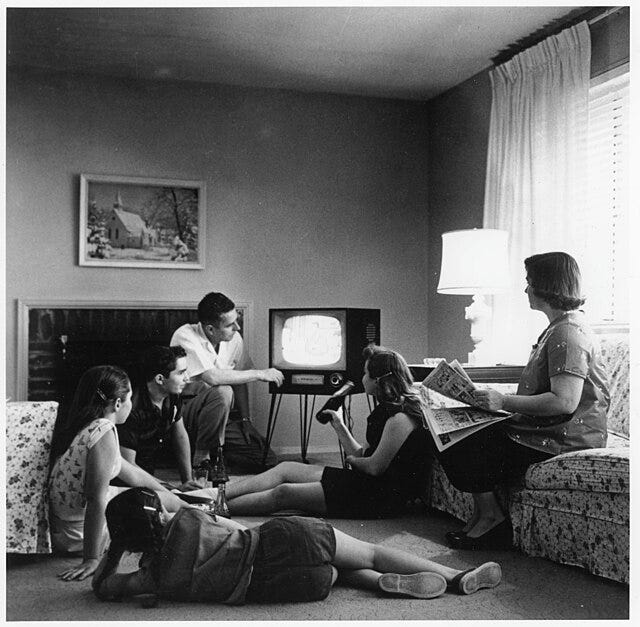
Prior to 1980, television news was consumed in 15 to 60-minute blocks once or twice a day. In 1980, CNN launched what would come to be known as the 24-hour news cycle. A little more than a decade later, CNN gained notoriety for its coverage of the first Gulf War. People at home could stay tuned moment to moment on updates of the war on the ground. I remember this time because my brother-in-law was stationed overseas in the Persian Gulf with the US Navy. I was young, but I felt a direct connection to the soldiers that were fighting. We tied a yellow ribbon around our tree in solidarity.
My mom didn’t yet have cable television, so we didn’t watch it constantly. But this period in the 1990s created competitors in the 24-hour news cycle game, including Fox News, MSNBC, and CNBC. By the time the O.J. Simpson murder trial aired in 1995, we did have cable television, and the continuous all-day coverage was mesmerizing. The 24-hour news cycle was solidified and became a normal part of life when the internet exacerbated the constant, round-the-clock news updates.
Feeds on Negativity
Humans have a negativity bias. We pay more attention to, are more influenced by and more likely to remember negative events over positive ones. This is most likely because we protectively evolved to pay more attention to threats so we could adapt and survive. Our brains are still wired this way, even though we are no longer running from sabretooth tigers.
One study showed that adding more negative words to a headline increased the click‑through rates, even when the story was similar. Negative stories feel more urgent and credible, so people are more likely to click, believe, and discuss them. Since emotionally charged, anger‑ or fear‑inducing posts reliably generate higher engagement, they are optimized by news outlets and social media algorithms to get more likes and clicks. So, staying glued to news and social media feeds is basically flooding our nervous system with negativity.
Additionally, this results in rabbit holes in which we are inundated with a singular opinion. Only learning about one perspective of any event does not increase your knowledge, it is only confirming what you already believe. Responsible news engagement requires us to look at different angles, engage our critical thinking and come to conclusions on our own, not based on what a computer program suggests will make us angrier.
Our Nervous System and the News
The human nervous system was not built to be in constant hyper-vigilance of worldwide atrocities. When we see upsetting stories, our brain can interpret them as threats, triggering the sympathetic system, causing adrenaline and cortisol to rise, heart rate and breathing to speed up, and muscles to tense. This can happen even though the threatening story is on a screen. Our amygdala responds to emotionally intense images and stories, not just physical danger. Repeated activation via doomscrolling and 24/7 news can leave the nervous system in a state of chronic hyper‑arousal, which is linked to anxiety, irritability, sleep disruption, headaches, and blood pressure changes. Overtime, people may exhibit trauma response patterns. This has been found to be true even when the news is playing in the background and you’re not actually paying attention to it.
If you are already a sensitive person such as me, the symptoms are likely to be worse. You are of no good to the world if your mental health is disrupted. I learned this the hard way after finding myself constantly on edge and quick to anger. I was doing myself and everyone around me a disservice by continuing to consume the news at the rate I was going.
My Journey with Reducing News Consumption
In 2016 after Donald Trump was elected president, I stopped listening, reading and watching the news. I would love to say that it was in protest, but it was mostly due to overwhelm. Well, first it was shock. I suddenly realized that my nation was not what I thought it was. I couldn’t handle all the reports explaining why Hilary Clinton lost, analyzing where the Democrats went wrong and all the justifications for this disappointing outcome. After a while I realized that I preferred to not engage with the news. I felt genuinely better not being inundated with the constant world report.
You Don’t Actually Need the News
The thing that most people don’t realize is that you don’t actually need to attend to the news to learn the news. First, people around you are constantly talking about the news. Open your ears to it and you will begin to notice. Especially if you have politically minded friends and family. Eric is the most updated person I know. Because of his years as a journalist and his work in communications, he always has one train of thought focused on what is happening in the world. Due to this, the news was unavoidable. If something major or interesting happened, I knew about it. If I was interested enough, I would do my own research and learn more.
Second, if you are on social media, you are always watching the news. Even though I didn’t intentionally watch, read or listen to the news, I was still aware of what was happening via my social media feed. I tended to follow people who posted political content. I soon learned that this was problematic when my news became one-sided algorithm fed. I learned this with an unnerving intensity after October 7th, 2023 when all the political content I followed ended up posting drastically misinformed, often antisemitic information all over my feed. At that time, I left social media too for the same reason I left all other news sources, my nervous system couldn’t hack it. Looking at my social media feed only enraged me the way news media did when Trump first got elected. My news sources dwindled greatly.
For the next couple of years, all my news came from word of mouth. Sometimes I felt completely out of it. People brought up current events and I stared dumbfounded. Embarrassed I might change the subject or otherwise ask them to fill me in. I intermittently looked up news stories I heard about to learn what was happening, but otherwise I was naïve. Overall, though challenging, I don’t think this was harmful in any way. I did what I needed to do at the time to get by.
You Don’t Have to Bear Witness
This may be controversial (maybe this entire post is controversial) but you don’t have to bear witness to other people’s pain to be a good person. Soon after I left social media, I was in a group for women entrepreneurs and explained why I had to leave Instagram and Facebook even though my business might suffer since I used them for marketing. A woman I barely knew said to me, “You are irresponsible to close your eyes to what is happening. It is our responsibility to bear witness to the pain and suffering of others.” She claimed that she had authority on the subject because she was gay and her wife was Black. I didn’t know what this had to do with my experience, but I let it go and spoke to the moderator later who agreed with my confusion.
I was deeply offended. Going off social media because people I once respected and followed for their fight against discrimination started using antisemitic cliches is not irresponsible. It is very responsible to myself. Ancestral trauma and epigenetics were causing my entire system to fire on high, and I could find no peace online. It was hard enough seeing it on every corner and from people I knew but there was no reason to voluntarily bear witness online.
The idea of bearing witness comes from Elie Wiesel, a holocaust survivor, author, and Nobel Peace Prize recipient who said that “his duty is to bear witness for the dead and for the living,” and that he has “no right to deprive future generations of a past that belongs to our collective memory.” When people apply Wiesel’s framing to everyday news and media feeds, they are saying, do not look away so that the suffering of others disappears. Perhaps this woman in the meeting did not realize that my cultural, experiential and familial connection to Israel made it impossible for me to look away. I didn’t need Instagram to remind me.
What I am saying is that staying informed of what is happening in the world is a means of recognizing other people’s vulnerability and struggles and inspiring ways in which you may be able to respond, not with virtue signaling, but with donating, voting or speaking up to your government representatives. Staying informed does not mean to consume horror endlessly. Because on the flip side, constant exposure can exceed our capacity to make meaning and overwhelm us out of doing anything because nothing seems like it will make a difference. Constant witnessing can lead to news fatigue and emotional burnout. Responsible witnessing means limiting your intake and seeking sources that inform without crushing.
Since the hostage return and ceasefire in the Israel-Hamas war, I have begun to reintroduce the news back into my life. While antisemitism is still growing globally, my news fast allowed me to be better resourced now to witness it. I am able to witness and empathize with others’ pain in the Ukraine, Middle East, Sudan and in my own country where people are struggling economically and immigrants are living in fear. I have reintroduced the news back into my life by creating a news diet that works for me.
Quick note: For the sake of honesty, I want to point out that even with my news diet in place, I still find that reading the news is often frustrating, disempowering and depressing. Trump’s reign cannot arrive quickly enough for me, and I just hope he doesn’t completely demolish our democracy on his way out.
How to Create Your Personal News Diet
As with a food diet, dieting is kind of hard. You are restricting things from your life that have become habitual and breaking habits are never easy. If you are like Eric and feel that you are fully capable of compartmentalizing the news without it affecting your everyday wellbeing, then you’re probably doing a good job of creating information balance in your life. However, if you are like me and notice that the news’s negativity can be overwhelming and trickle into other areas of your life, then it may be worthwhile for you to commit to trying a news diet and see how you feel. If you are interested in learning more, read on.
My hope is that the following 8 tips for how to create a simple and doable news diet gives you permission to step away from the battering new cycle and trending horrors and listen to your body, prioritize your values, and bring more peace and positivity into your life. This list is distilled from years of experience, experiments, and careful research and is shared exclusively with our paid subscribers. Thank you for supporting this work and making it possible to dig deeper together.
